
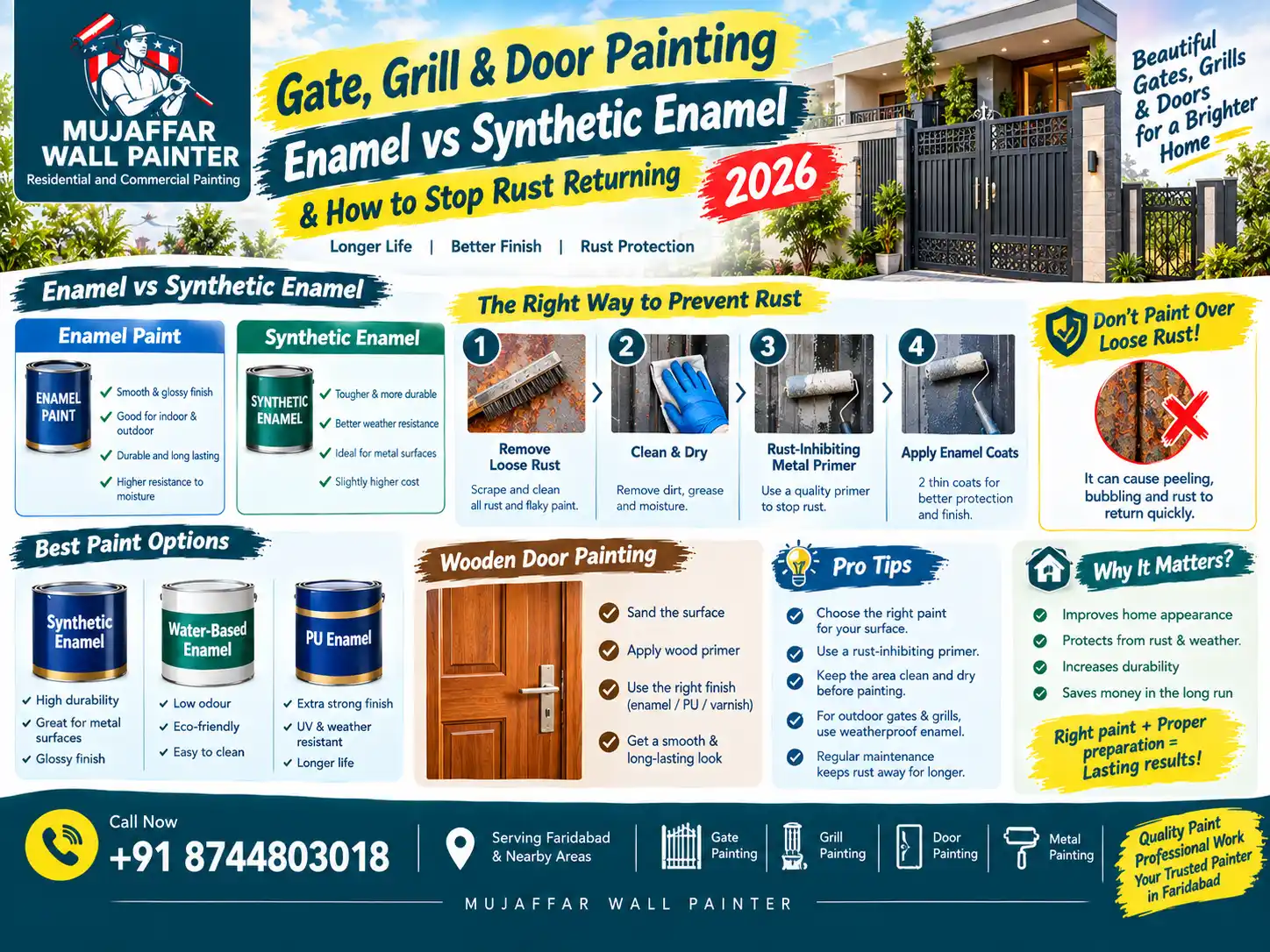
Gate, Grill and Door Painting: Enamel vs Synthetic and How to Stop Rust Returning (2026)
Gate, Grill and Door Painting: Enamel vs Synthetic and How to Stop Rust Returning (2026)
Short answer: on an outdoor iron gate or grill, rust coming back is almost always a preparation problem, not a paint-brand problem. The reliable sequence is: remove loose rust and old paint, treat what is left, apply a rust-inhibiting metal primer straight away, then finish with two coats of solvent-based synthetic enamel or PU enamel. Wooden doors follow the same idea with a wood primer instead. Below you will find what “enamel” and “synthetic enamel” really mean in Indian paint shops, a step-by-step method, a surface-by-surface product guide, and a maintenance routine that suits Faridabad’s dust and monsoon humidity.
Enamel vs Synthetic Enamel: What You Are Actually Choosing Between
At the paint counter, “enamel” and “synthetic enamel” are often used for the same thing. The common enamels sold for metal and wood in India are solvent-based, made with synthetic resins, and dry to a hard, glossy film. So the more useful question is which type of enamel suits your surface and your exposure.
| Type | What it is | Best for | Watch out for |
|---|---|---|---|
| Synthetic enamel (solvent-based) | Traditional glossy enamel made with synthetic resins and thinned with solvent | Outdoor gates, grills, railings, exterior wood | Strong smell, slower drying, solvent needed for cleaning brushes |
| Water-based enamel | Water-thinned enamel with low odour and quicker drying | Indoor doors, indoor grills, wood in occupied rooms | Check the tin for metal and exterior suitability, and for the recommended primer |
| PU enamel | Polyurethane-based enamel sold as a premium option for tougher weather exposure | Gates and grills in direct sun and rain | Higher cost; works best when you follow the full recommended primer system |
| 2-pack epoxy finish | Two-component coating mixed with a hardener before use | Harsh or industrial exposure | Limited working time once mixed, and usually more than a home gate needs |
Rule of thumb: for outdoor gates and grills that take sun, dust and monsoon rain, choose solvent-based synthetic enamel or PU enamel over a proper metal primer. For indoor doors and grills, or wherever odour matters (occupied rooms, children, elderly family members), a water-based enamel is easier to live with. Whatever you pick, use the primer the manufacturer recommends for that topcoat, and always confirm on the tin that the product is meant for metal or wood and for your exposure.
Why Rust Keeps Coming Back
- Rust was painted over, not removed. Loose rust under a new coat keeps spreading and lifts the paint from below, often within a season.
- No primer, or the wrong one. Enamel alone does not give bare steel the protection of a rust-inhibiting primer.
- Bare metal left unprimed. Freshly sanded steel can start to rust again quickly, especially in humid air.
- Thin or missed coverage on joints, welds, edges, undersides and the bottom rail, which is where water collects.
- Water trapped inside hollow sections with open ends and no drainage.
- Chips and scratches left alone, which let moisture reach the metal.
- Painting in damp or very hot conditions, which traps moisture or makes paint dry too fast.
How to Paint a Rusty Gate or Grill: Step by Step
You will need a scraper, wire brush, sandpaper (or a power sander), rust converter, a degreaser or thinner, metal primer, enamel, brushes or a small roller, masking tape, a drop cloth, and a mask, gloves and goggles.
- Check the old paint. Cut a small X through the paint with a sharp blade. If the paint lifts, it has to come off. If it stays firmly in place, you can sand it and keep it.
- Protect yourself. Wear a mask, gloves and goggles. Avoid dry sanding very old paint, which can contain lead, and keep children and pets away. Ventilate well when using solvent-based products.
- Clean the surface. Wash off dust and dirt, remove grease, and let the metal dry fully.
- Remove loose rust and paint. Use a scraper, wire brush and sandpaper until you reach sound metal and firm paint edges. Sand the edges so they blend smoothly instead of leaving ridges.
- Treat the remaining rust. In pits and joints you cannot fully sand out, apply a rust converter or rust remover exactly as the label directs, then wipe off any residue.
- Fill dents and weld marks with a knifing paste or metal filler if you want a smooth finish, then sand it flat.
- Prime quickly. Apply one coat of rust-inhibiting metal primer, or two on heavily rusted patches. On a gate with sound old paint, prime only the bare metal. Brush into joints and cover edges, welds and undersides.
- Apply the enamel. Stir well and thin only as the tin allows. Put on two thin, even coats rather than one heavy one, and respect the recoat time printed on the tin. Avoid midday sun and windy, dusty periods.
- Let it cure. Keep the gate or door from closing against the frame until the paint is dry enough that it will not stick, and oil the hinges once the paint has hardened.
Surface-by-Surface Product Guide
Use this table to match the surface to the right primer and topcoat. If your tin says something different, the tin wins.
| Surface | Prep and primer | Topcoat | Watch out for |
|---|---|---|---|
| New bare mild-steel gate, grill or railing | Remove mill scale and oil, then 1–2 coats of red oxide or another metal primer | 2 coats of synthetic enamel or PU enamel | Prime the same day; coat joints, edges and undersides |
| Old gate with rust | Remove loose rust and paint, treat the rest with a rust converter, then 2 coats of rust-inhibiting primer (zinc-based or epoxy primer for severe corrosion) | 2 coats of synthetic or PU enamel | Never paint over loose or flaking rust |
| Old gate, paint still firmly stuck | Scuff-sand, then spot-prime bare metal only | 2 coats of enamel over the whole surface | Sand the edges of each spot so no ridges show |
| Balcony or staircase railing (hollow sections) | Same as a gate; seal open ends | Synthetic or PU enamel | Water trapped inside hollow pipes rusts the metal from within |
| Galvanised (GI) sheet, shutter or grill | A primer labelled for galvanised metal (plain red oxide may not grip new galvanised surfaces) | The enamel recommended for that primer | Clean and degrease thoroughly |
| Aluminium frames or grills | Etch primer made for aluminium | Synthetic enamel | Check whether it is already coated; the surface must be clean and lightly keyed |
| Exterior wooden door | Sand, fill dents, apply wood primer | PU enamel or synthetic enamel, 2 coats (or PU polish for a natural look) | Seal the top and bottom edges; never paint damp wood |
| Interior wooden door | Sand, apply wood primer | Water-based or synthetic enamel in satin or gloss | Choose water-based if odour is a concern; remove or mask hardware |
Product examples from major brands: Asian Paints Apcolite Premium Gloss Enamel (solvent-based), Apcolite Rustshield PU Enamel, Royale Luxury Enamel (water-based) and Smartcare High Performance Red Oxide Metal Primer, or Nerolac Synthetic Hi-Gloss Enamel. Other brands have equivalent ranges, and our paint brand comparison covers how they differ. Product names and availability change, so confirm with your dealer and follow each product’s data sheet.
Choosing a Finish and Colour
Gloss is easy to wipe clean but shows every dent and pit on an old gate, while satin hides imperfections better. Dark colours on metal get hot in direct sun, so think about how the gate is used. For colour ideas that suit Faridabad homes, see our exterior colour trends guide.
Wooden Doors: What Changes
- Sand off glossy old paint or varnish so the primer can grip.
- Fill dents and gaps with wood filler, then sand smooth.
- Apply a wood primer before the enamel. Skipping it often leads to patchy colour.
- Seal the top and bottom edges of exterior doors, where moisture enters first.
- Remove handles, locks and hinges where possible, or mask them carefully.
- Paint only when the wood is dry. Our seasonal painting guide explains the best months in Faridabad.
How to Stop Rust Returning: A Simple Maintenance Routine
- Before the monsoon: inspect every gate and grill, touch up bare spots with primer and enamel, and make sure hollow sections can drain.
- After the monsoon: look for blisters, rust streaks and chipped corners, and fix them early while they are small.
- Whenever you spot a chip: touch it up quickly with primer and enamel. A small chip is the usual starting point for a rust patch.
- Keep the surface clean: wipe off dust with mild soapy water, and avoid steel wool or harsh chemicals that scratch the film.
- Look after hinges and latches: lubricate moving parts, and keep oil away from any area you plan to repaint.
- Repaint before the film fails: most gates need a fresh topcoat every few years depending on sun and rain exposure, so inspect regularly instead of waiting for visible rust.
Common Mistakes to Avoid
- Using wall emulsion on metal. It is made for walls and tends to chip and let rust through.
- Painting over dust, grease or damp metal
- Applying one thick coat instead of two thin ones
- Mixing products from different systems without checking compatibility on the tin
- Painting hinges and latches shut because the gate was not masked or kept open
- Skipping the primer because the enamel is advertised as rust-resistant
For general painting errors, see our guide to common house painting mistakes.
DIY or Hire a Painter?
A small grill, a single door or light surface rust is a reasonable DIY job if you follow the steps above. It is worth hiring a professional for heavy rust and pitting, tall or large gates, welding or repair work, spray finishing, or when several surfaces need doing at once. During a free site visit we check the condition of the metal and wood and give a written quotation that lists rust treatment, primer and enamel coats separately. You can also see the rest of our painting services.
Frequently Asked Questions
Can I paint directly over rust?
Not if the rust is loose or flaking. Remove it first, treat what remains with a rust converter, then prime. Painting over loose rust lets it keep spreading under the new coat.
Which paint is best for an iron gate in India?
For outdoor gates, use a rust-inhibiting metal primer followed by two coats of solvent-based synthetic enamel or PU enamel. Indoors, or where odour is a concern, a water-based enamel works well. Check the tin for the recommended primer.
Is enamel the same as synthetic enamel?
In most Indian paint shops, yes. The common enamels for metal and wood are solvent-based synthetic enamels. The more useful distinction is solvent-based versus water-based versus PU enamel.
How many coats do I need?
Usually one to two coats of primer (two on heavily rusted patches) and two coats of enamel.
Do I need to repaint the whole gate or just the rusty spots?
If the rest of the paint is sound, sand the edges, spot-prime the bare metal, then apply enamel over the whole surface so the colour and gloss stay even.
Why is paint bubbling or peeling on my gate?
Common causes are rust under the film, trapped moisture, a dirty or greasy surface, a skipped primer, or painting in humid or very hot weather.
Can I use wall paint on grills?
It is not recommended. Wall emulsion is not designed for metal and usually chips and rusts through. Use a metal primer and an enamel instead.
How long will a repainted gate stay rust-free?
It depends on the quality of the preparation, how exposed the gate is, and how well you maintain it. Careful prep plus quick touch-ups of chips is what makes the paint last.
Page last updated: October 2026.

1 Comment
10 Common Painting Mistakes to Avoid at Home (2026 Guide)
October 11, 2026[…] Not all paints bond to each other. Painting water-based emulsion directly over an old oil-based enamel or synthetic surface (common on older doors, grills, and some feature walls) often causes the new coat to peel or chip within weeks, no matter how good the prep was. For the gates, grills and doors themselves, see our gate, grill and door painting guide. […]