
How Many Litres of Paint Do You Need? Room-by-Room Calculator (2026)
How Many Litres of Paint Do You Need? Room-by-Room Calculator (2026)
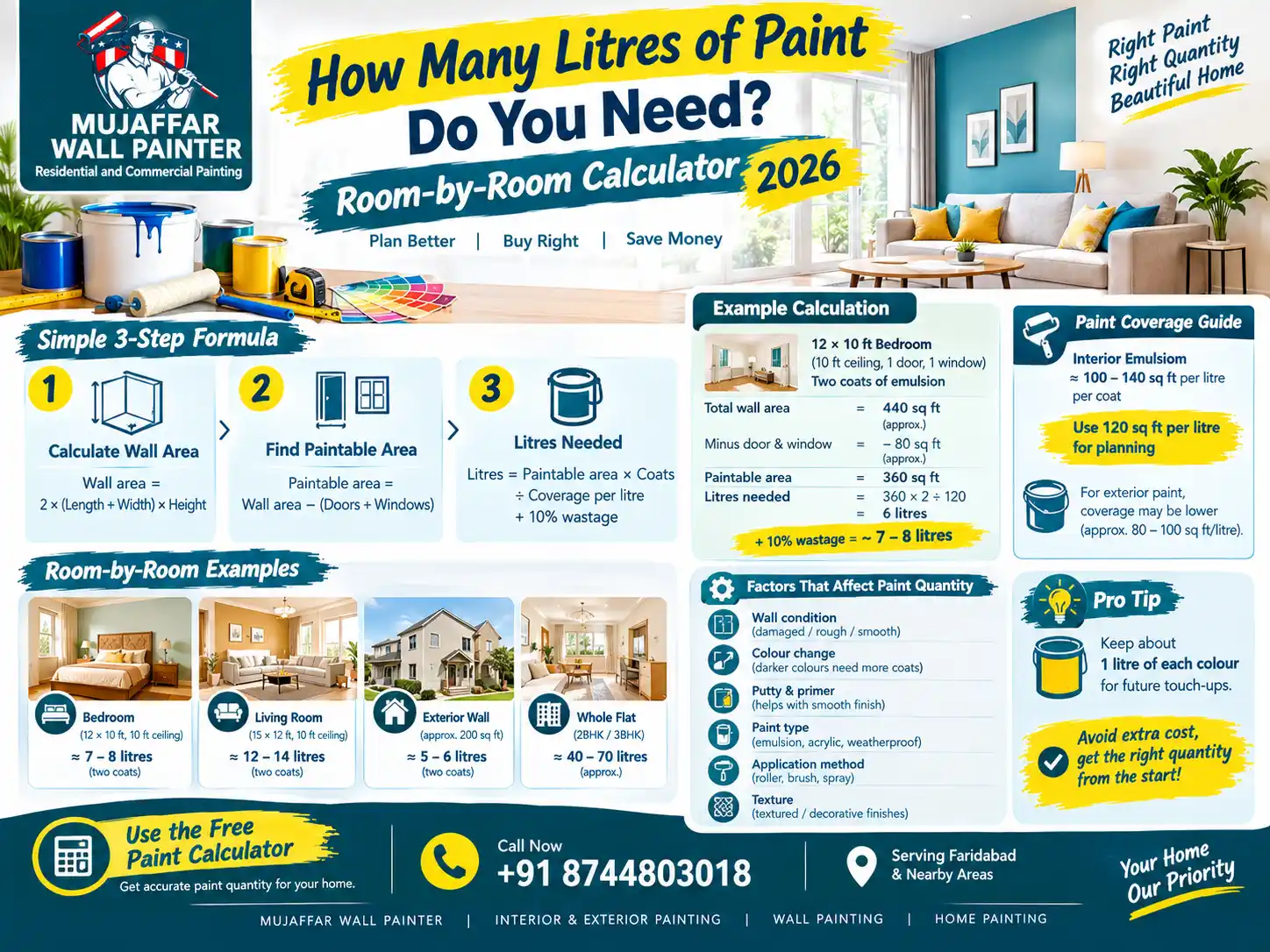
Short answer: a typical 12 × 10 ft bedroom with 10 ft ceilings needs roughly 7 to 8 litres of emulsion for two coats. The general formula is litres = (wall area − doors and windows) × number of coats ÷ coverage per litre, plus about 10% extra. This guide shows you how to work it out for any room, with a free calculator and worked examples in square feet and litres, the units most Indian painters and paint shops use.
The Paint Quantity Formula (in 3 Lines)
- Wall area = 2 × (length + width) × height
- Paintable area = wall area − (doors + windows)
- Litres needed = paintable area × coats ÷ coverage per litre, then add 10% for wastage
For coverage, a safe planning figure for interior emulsion is about 120 sq ft per litre per coat. Most brands fall somewhere between 100 and 140 sq ft depending on the product and the wall. If your tin prints coverage in m² per litre, multiply by 10.76 to convert to sq ft.
Free Paint Calculator (Sq Ft & Litres)
Enter your measurements in feet. The calculator deducts doors and windows, applies your coats and wastage, and suggests pack sizes (1, 4, 10 and 20 litre).
How to Measure Your Room (Step by Step)
- Measure the length and width of the room along the floor, and the height from floor to ceiling. Most Indian homes have ceilings around 9 to 10 ft, but measure rather than assume.
- Work out the wall area: add length and width, double it, then multiply by the height.
- Deduct openings. A standard door is roughly 7 × 3 ft (21 sq ft) and a typical window about 4 × 3 ft (12 sq ft). Big sliding doors and French windows are larger, so measure them.
- Decide on coats. Two coats is the norm for a proper finish. Use three for a dark-to-light colour change or patchy, porous walls, and one only for a fresh coat of the same colour over a sound surface.
- Divide by coverage and multiply by the number of coats, then add roughly 10% for wastage, corners, roller loss and touch-ups.
How Much Does 1 Litre of Paint Cover?
There is no single number, because coverage depends on the product and the wall. Use these as planning figures, and let the figure printed on your tin override them.
| Paint / surface | Planning figure (per coat) |
|---|---|
| Interior emulsion on smooth, puttied walls | About 100–140 sq ft per litre (use 120) |
| Water-based wall primer | About 100–140 sq ft per litre on smooth walls; porous or new plaster drinks more |
| Exterior weatherproof paint on textured or rough plaster | About 80–120 sq ft per litre (use 100) |
| Enamel on wood or metal | About 100–140 sq ft per litre |
Rough, textured or very porous surfaces absorb more paint, so coverage per litre drops. Spraying also tends to use more paint than rolling. Distemper and some other products are sold by weight, so follow the pack instructions for those.
Worked Examples
Example 1: A 12 × 10 ft bedroom (walls only)
- Wall area: 2 × (12 + 10) × 10 = 440 sq ft
- Deduct 1 door (21) and 1 window (12): 440 − 33 = 407 sq ft
- Two coats: 407 × 2 = 814 sq ft of paint cover
- Divide by 120 sq ft per litre: 814 ÷ 120 = 6.8 litres
- Add 10% wastage: about 7.5 litres
Buy: two 4 L packs (8 L), or one 10 L pack if you want leftover paint for touch-ups.
Example 2: A 15 × 12 ft living room with ceiling
- Wall area: 2 × (15 + 12) × 10 = 540 sq ft
- Deduct 2 doors (42) and 2 windows (24): 540 − 66 = 474 sq ft
- Walls, two coats: 474 × 2 ÷ 120 = 7.9 litres, plus 10% = about 8.7 litres
- Ceiling: 15 × 12 = 180 sq ft; two coats ÷ 120 = 3.0 litres, plus 10% = about 3.3 litres
Buy: one 10 L pack for the walls and one 4 L pack of ceiling paint.
Example 3: An exterior wall
A 40 ft wide, 25 ft high front facade is 1,000 sq ft. Deduct about 120 sq ft for windows and the main door, leaving 880 sq ft. Exterior plaster is usually rougher, so use 100 sq ft per litre: 880 × 2 coats ÷ 100 = 17.6 litres, plus 10% = about 19.4 litres. That is roughly one 20 L drum. For preparation and paint specifications, see our exterior painting service.
Example 4: A whole flat (rough estimate)
If you do not have room-by-room measurements yet, a common painter’s rule of thumb is that the paintable wall area comes to roughly 3 to 3.5 times the carpet area. It varies with layout, so treat this as a starting point only.
| Home | Typical carpet area | Wall paint, two coats (rough) |
|---|---|---|
| 1 BHK | About 600 sq ft | Roughly 33–39 litres |
| 2 BHK | About 900 sq ft | Roughly 50–58 litres |
| 3 BHK | About 1,300 sq ft | Roughly 72–84 litres |
Ceilings add roughly one extra litre per 60 sq ft of floor area for two coats (about 16 to 18 litres for a 900 sq ft flat). These figures assume a 120 sq ft per litre coverage and 10% wastage.
What Changes How Much Paint You Need
- Colour change: going from a dark or strong colour to a light one often needs a third coat or a good primer first.
- Wall condition: new plaster, old chalky walls and rough textures absorb more paint. A coat of primer evens this out.
- Putty and primer: these are separate products with their own quantities. Read the pack, or ask your painter to include them in the quotation.
- Application method: rollers and brushes use less paint than spraying.
- Paint type: premium emulsions often hide better, which can reduce the number of coats needed, so compare products. Our paint brand comparison covers the main options.
Common Mistakes When Estimating Paint
- Forgetting the ceiling, or buying wall paint for it when a dedicated ceiling paint is better
- Not deducting large windows and doors, which leads to over-buying
- Planning for one coat and running short on the second
- Buying in several trips, so the shade or batch differs slightly between tins. Buy everything in one go and mix tins together when painting a single wall.
- Skipping the 10% buffer, then finding the shop is out of your shade halfway through
More pitfalls are covered in our guide to common house painting mistakes.
Buying Tips: Pack Sizes and Leftover Paint
- Interior paints are commonly sold in 1, 4, 10 and 20 litre packs. A larger pack usually costs less per litre, so rounding up to a bigger pack is often worth it.
- Keep about a litre of each colour for future touch-ups. Close the lid tightly, store it upright in a cool place, and label it with the room and date.
- Paint quantity is only part of the budget. Putty, primer, labour and scaffolding all add up, so see our house painting cost guide by home size.
Want Exact Quantities for Your Home?
A calculator gives you a solid estimate, but real walls have niches, beams, uneven plaster and old paint. During a free site visit we measure your rooms, check the wall condition and give a written quotation that covers paint, putty and primer quantities. If you are repainting a new home, our new flat painting guide explains what to do first, and our service page lists everything we offer.
Frequently Asked Questions
How many litres of paint do I need for a 12 × 10 room?
With 10 ft ceilings, one door and one window, you need about 7 to 8 litres for two coats of emulsion on the walls, including 10% wastage. A ceiling would add about 2 to 3 litres.
How many square feet does 1 litre of paint cover?
Most interior emulsions cover about 100 to 140 sq ft per litre per coat on smooth walls. Use 120 sq ft for planning, and check the tin for your product’s actual figure.
How many coats of paint do I need?
Two coats is standard. A single coat can work when repainting the same colour over a sound surface, and a dark-to-light change or fresh plaster may need three.
Should I deduct doors and windows?
Yes, deduct them for a more accurate quantity. As a quick guide, a standard door is about 21 sq ft and a typical window about 12 sq ft. If you want a safety margin, skip the deduction for small windows and keep the 10% buffer.
How much extra paint should I buy?
Add about 10% for wastage, corners and touch-ups. Buy the whole quantity in one go so every tin comes from the same batch.
Does the ceiling need different paint?
Ceilings are usually painted with a dedicated ceiling paint, which is why the calculator shows ceiling litres separately from wall litres.
How accurate is this calculator?
It is a planning estimate based on the figures you enter. Wall texture, absorbency, the product and the application method all affect the real quantity, so confirm with the coverage printed on your tin or with your painter.
Page last updated: October 2026.

2 Comments
House Painting Cost Faridabad 2026: 1BHK to Villa Guide
October 8, 2026[…] tier, your budget stops being a guessing game. Not sure how many litres your rooms need? Try our free paint quantity calculator. Use the formula and tables above to get a realistic range for your home, then book a free site […]
15% Off Painting in Faridabad + 5-Year Warranty (Oct 2026)
October 15, 2026[…] Work out how much paint your rooms need with our free paint quantity calculator. […]