
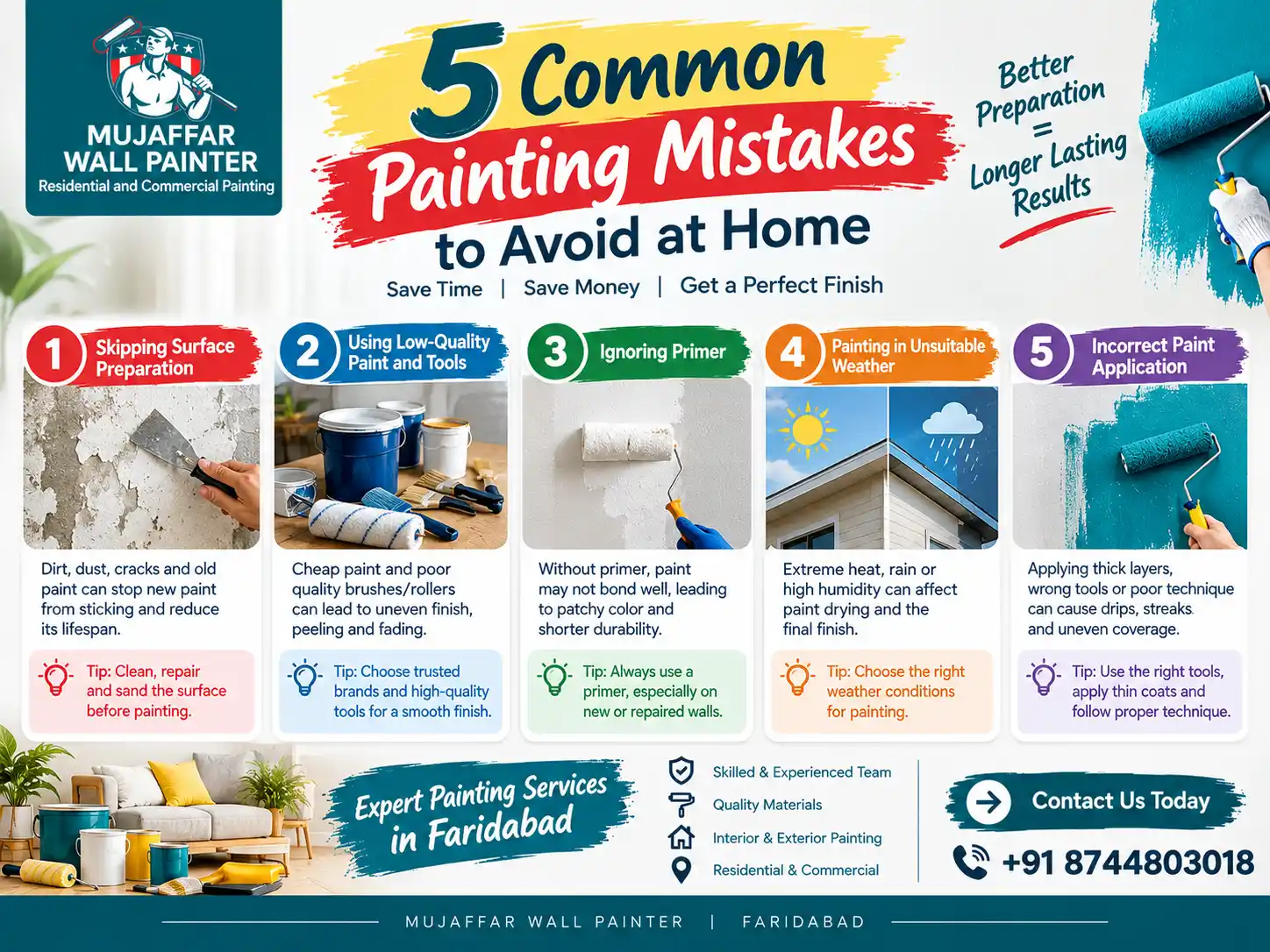
5+ Common House Painting Mistakes to Avoid at Home: Ultimate Guide 2026 + Checklist
5+ Common House Painting Mistakes to Avoid at Home (2026 Guide)
Painting your home seems simple until the walls start showing streaks, cracks, patches, or uneven tones. Most people make the same small errors, and those mistakes end up costing extra time and money. If you’re planning a home makeover, knowing the common painting mistakes to avoid at home will help you get a clean and long-lasting finish.
This guide walks you through everything in clear, simple language so you can paint confidently without stress.
Understanding Why Home Painting Mistakes Happen
Painting mistakes usually happen because of rushing, using the wrong tools, skipping prep work, underestimating the amount of paint needed, or misunderstanding how paint dries. When you know what causes the problems, you can prevent 90% of them.
Below, we break each mistake into easy steps so you can spot and fix them before picking up a brush.
Mistake 1: Poor Surface Preparation
Surface preparation is the biggest factor that decides whether your paint job lasts or starts peeling within months. Most homeowners skip cleaning, sanding, or repairing damage, which causes paint to sit loosely on the surface.
Why Prep Matters
Paint only sticks well when the surface is clean, dry, and smooth. Even small layers of dust or grease can block proper adhesion.
Typical Prep Steps
- Clean the wall with soap water
- Scrape off old flaking paint
- Sand the surface (and scuff glossy areas so new paint can grip)
- Fill cracks and holes
- Wipe with a microfiber cloth
This step alone improves the finish more than anything else.
Signs of Improper Surface Prep
Here’s how you can tell the wall wasn’t prepared properly:
- Paint chips or flakes within weeks
- Bubbles or blisters appear
- Patchy or darker spots show up
- Brush strokes look rough
- Wall looks dusty or uneven even after painting
If you’ve seen these issues before, poor prep was the root cause.
Mistake 2: Using Low Quality Paint and Tools
The temptation to save money often leads people to buy cheap paint and rollers. But low-quality tools waste more paint, create streaks, and make the job harder.
Problems Caused by Cheap Paint
- Thin coverage
- More coats required
- Faster fading
- Poor stain resistance
Problems Caused by Low-Quality Tools
- Roller lint sticks on the wall
- Brushes leave marks
- Uneven paint distribution
Investing in good materials gives a smoother, professional finish.
How Cheap Materials Damage the Final Look
If you’ve ever painted a wall and thought it looked dull or uneven, low quality supplies were probably the issue. Signs include:
- Patchy look even after two coats
- Roller marks visible from side angles
- Paint dries with uneven sheen
- Color looks washed out
Good tools don’t just make the job easier; they completely change the outcome.
Mistake 3: Ignoring Primer
Primer is the foundation layer that helps paint stick better, spread evenly, and look uniform. Most people skip primer to save time, but the final coat will always suffer.
Benefits of Using Primer
- Strong adhesion
- Hides old colors
- Reduces paint absorption
- Gives better sheen
- Long-lasting finish
Primer is especially important when painting over dark colors, damp walls, metal, or raw plaster.
When Primer Becomes Mandatory
Primer is required in these cases:
- New walls or fresh putty
- Repainting dark surfaces
- Walls with stains
- Uneven or repaired areas
- Moisture-prone zones like kitchens and bathrooms
Skipping primer creates an unprofessional look, no matter how good the paint quality is.
Mistake 4: Painting in the Wrong Weather Conditions
Temperature and humidity are often ignored during home painting. However, paint dries differently depending on the weather.
Effects of Bad Weather
- Slower drying
- Sticky surface
- Blistering
- Cracking
- Uneven sheen
Ideal Temperature and Humidity Ranges
To avoid problems, paint when:
- Temperature: 10°C to 35°C
- Humidity: 40% to 70%
- No direct sunlight on the wall while painting
- No rainfall for at least 24 hours
In Faridabad, the most reliable painting window is October to March, when humidity and temperature both sit closer to the ideal range; peak monsoon months are best avoided for exterior work.
Mistake 5: Applying Paint Incorrectly
Even if you have great paint and tools, poor technique can ruin the final look.
Common Application Errors
- Overloading the roller
- Not maintaining a wet edge
- Uneven pressure
- Painting too slowly
- Using the wrong stroke pattern
Technique matters as much as paint quality.
Common Application Errors Explained
- Overlapping Strokes creates darker patches.
- Dry Brushing happens when too little paint stays on the brush.
- Painting Against Dry Edges leads to lap marks.
- Not Stirring Paint Properly causes color variation.
Mistake 6: Underestimating How Much Paint You Need
Guessing the quantity is one of the most common DIY errors. Buy too little and you risk a mismatched second batch; buy too much and you waste money.
Simple Way to Estimate Paint Quantity
- Measure the total wall area (length × height of each wall, minus doors and windows).
- Check the coverage rate printed on the paint tin (usually per litre per coat).
- Divide the wall area by the coverage rate, then multiply by the number of coats (usually 2).
- Add 10% extra for touch-ups and future repairs.
If in doubt, ask your paint dealer or painter to confirm the quantity against your measurements before buying.
Mistake 7: Not Protecting Floors, Furniture, and Fixtures
Paint splatters and drips are avoidable, but only if you prep the room, not just the wall.
- Cover floors with drop cloths or plastic sheets, not just old newspaper
- Move furniture to the center of the room or out entirely, and cover what stays
- Remove switchboards, curtain rods, and wall fittings where possible, or mask them well
Mistake 8: Poor Painter’s Tape Technique
Tape is meant to give crisp, clean edges but used wrong, it does the opposite.
- Press tape down firmly along the full edge so paint can’t seep underneath
- Remove it slowly while the paint is still slightly wet to prevent peeling the dried edge
- Never leave tape on for days it can leave residue or pull off patches of paint
Mistake 9: Recoating Too Soon
Applying a second coat before the first has properly dried is a common source of streaks, dragging, and uneven sheen.
- Follow the drying and recoat time printed on the paint tin — most emulsions need 4 to 6 hours minimum between coats
- Humid weather extends drying time, so check the wall is fully dry to the touch before recoating
Mistake 10: Painting Over the Wrong Paint Type
Not all paints bond to each other. Painting water-based emulsion directly over an old oil-based enamel or synthetic surface (common on older doors, grills, and some feature walls) often causes the new coat to peel or chip within weeks, no matter how good the prep was. For the gates, grills and doors themselves, see our gate, grill and door painting guide.
- Do a quick check: rub a cotton swab with methylated spirit or nail polish remover on the old surface if paint comes off easily, it’s likely water-based; if it doesn’t, it may be oil-based/enamel.
- If the old surface is oil-based, sand it thoroughly and use a bonding primer made for the switch before applying emulsion.
- If you’re using two different sheens on the same job (say, matte on walls and semi-gloss on trim), label the cans clearly so no one grabs the wrong one mid project.
Practical Tips to Get a Professional Finish
Here are simple ways to get cleaner results:
Choosing the Right Paint Type
Different rooms need different paint qualities:
- Matte for bedrooms
- Satin or Eggshell for hallways
- Semi-gloss for kitchens
- High-gloss for doors and frames
Choose based on durability needs, and always use exterior-rated weatherproof paint outdoors interior paint isn’t built to handle sun, rain, or temperature swings and will fail fast outside.
Investing in Quality Tools
Use:
- Microfiber rollers
- Soft nylon brushes
- Extension poles
- Painter’s tape
- Sandpaper (120 to 220 grit)
Good tools save effort and improve precision.
Maintaining the Correct Technique
- Work in small sections
- Use long, smooth strokes
- Keep pressure even
- Always blend wet edges
- Apply two coats for best results
This ensures a clean, streak-free look.
Quick Pre-Painting Checklist
- ☐ Measure walls and calculate paint quantity (add 10% extra)
- ☐ Clean, sand, and repair the surface
- ☐ Apply primer where needed
- ☐ Check the weather forecast for the next 24–48 hours
- ☐ Cover floors, furniture, and fittings
- ☐ Apply painter’s tape carefully along edges
- ☐ Stir paint thoroughly before starting
- ☐ Respect drying time between coats
- ☐ Check whether the existing paint is oil-based or water-based before recoating
Conclusion
Avoiding these common painting mistakes at home is the simplest way to get a professional finish without hiring experts. With proper prep, good materials, correct quantity planning, and the right technique, your walls will look smoother and last longer. Take your time, follow the checklist above, and enjoy the results. Not sure about color or design direction first? Check our guide on modern wall painting ideas and 2026 pricing, or browse the best wall color combinations for 2026. If you’d rather skip the risk entirely, our painting service in Faridabad handles prep, priming, and application for you.
FAQs
1. What’s the biggest painting mistake to avoid?
Skipping surface preparation is the biggest mistake because it affects adhesion and durability.
2. How many coats of paint do I need?
Most walls need two coats for a solid, even finish.
3. Can I paint without primer?
Yes, but only on already painted walls of similar color. Otherwise, primer is required.
4. What is the best time to paint indoors?
Mild weather with low humidity works best in Faridabad, October to March is usually the most reliable window.
5. How do I stop roller marks?
Use a microfiber roller and keep a wet edge while painting.
6. Is expensive paint worth it?
Yes, because it lasts longer and offers better coverage.
7. How much paint do I need for a room?
Measure the wall area, divide by the coverage rate on the paint tin, multiply by the number of coats, and add about 10% extra for touch-ups. For worked examples and a quick tool, use our free paint quantity calculator.
8. How long should I wait between coats?
Most emulsions need at least 4 to 6 hours to dry before recoating; humid weather can extend this, so check that the wall is fully dry to the touch first.
9. Can I paint water-based emulsion over old oil-based paint?
Not directly it often peels. Sand the surface well and apply a bonding primer designed for oil-to-water transitions first, or ask your painter to test the old surface before starting.

6 Comments
Top 10 Wall Painting Ideas for Modern Homes in Faridabad (2026)
September 15, 2026[…] see our guide on choosing the perfect paint colour combinations, and before you start, check these common painting mistakes to avoid. If you’d rather leave it to the experts, see our wall painting services in Faridabad for a […]
Best Wall Color Combinations for your Homes How to Choose the Perfect Paint Color for Your Living Room + Ultimate Guide + 15 Expert Tips - Best House Painter in Faridabad
September 15, 2026[…] a full repaint? See our detailed guide on common painting mistakes to avoid for a longer […]
How to Choose the Best Painting Contractor in Faridabad (2026)
September 16, 2026[…] on a painter, you might also want to browse our guides on wall color combinations for 2026 and common painting mistakes to avoid so you walk into the project with a clear plan. If you’d rather skip the vetting altogether, […]
Exterior Wall Painting & Waterproofing Guide for Faridabad (2026)
September 17, 2026[…] — it isn’t built for UV, rain, or temperature swings and will fail fast. See our guide on common painting mistakes to avoid for […]
How Many Litres of Paint Do You Need? Free Calculator (2026)
October 8, 2026[…] More pitfalls are covered in our guide to common house painting mistakes. […]
Gate, Grill & Door Painting: Enamel vs Synthetic (2026)
October 15, 2026[…] For general painting errors, see our guide to common house painting mistakes. […]